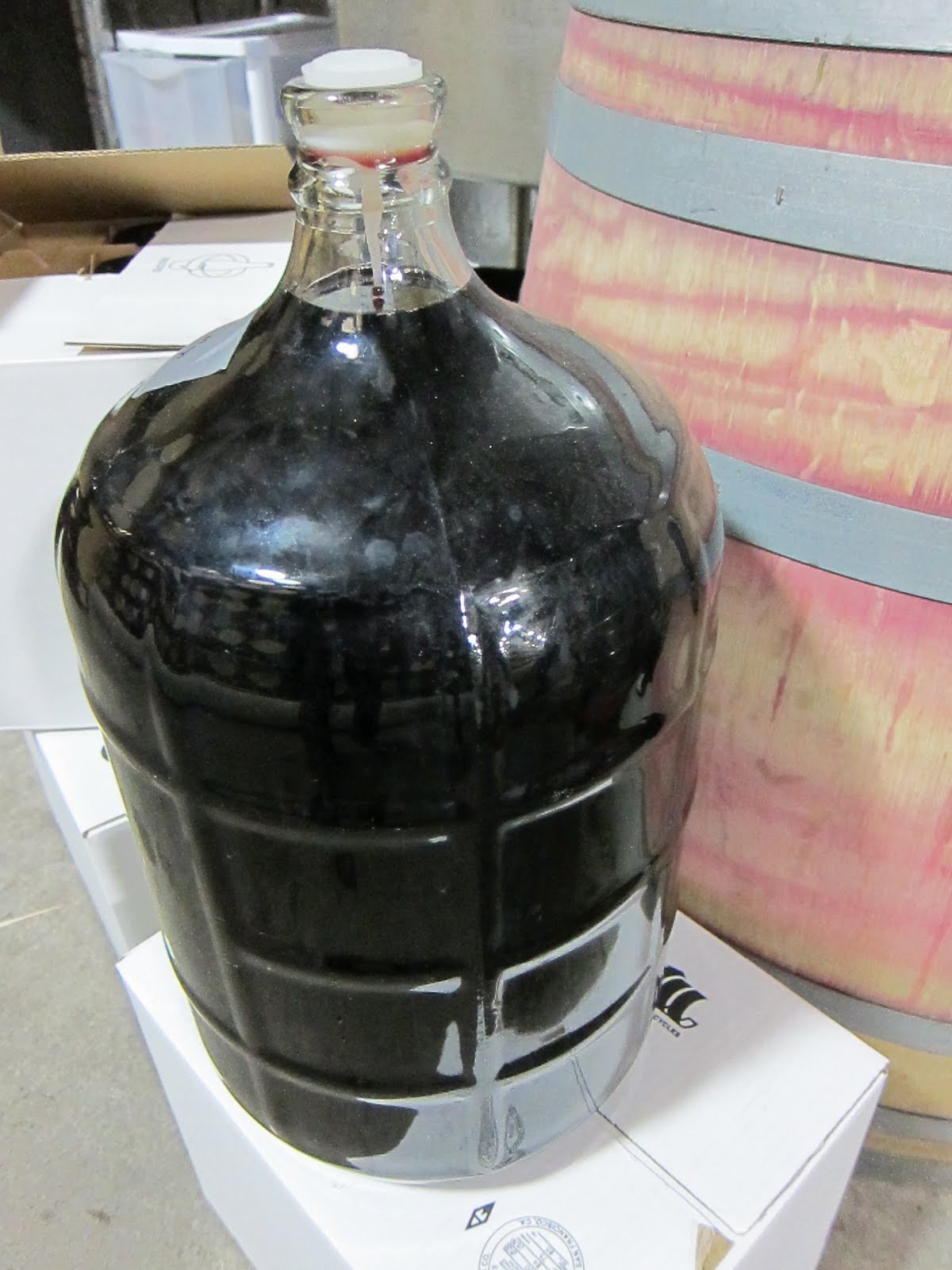
Showing posts with label winemaking. Show all posts

Saturday, September 7, 2013

Growing slow and acting on instinct.


This Monday, we will put our modest .97 ton lot of Manchester Ridge Chardonnay to bottle and with so doing Trail Marker Wine Company will be official. Actually, with all the hurdles of the ABC, TTB, BOE and LLC (have I lost you yet?!), TMWC won't be official in the eyes of the law until mid November at the earliest. But we will have made and bottled our very own wine, our very own way, from grape to bottle and that counts for something. 

When we started Trail Marker Wine Company last October, the idea was to grow it ultra slowly by one ton each year and to do only Chardonnay for the first two or even three years. It was a good plan but life has a way of making it's own plans. 

While sourcing a second Chardonnay vineyard in the Santa Cruz Mountains, we accidentally fell in love with a Pinot Noir vineyard while we were there.

In relaying the experience to close friends and family, I've compared it to that moment when you fall hard for delicious produce at the farmer's market or that perfect pair of wedge sandals you feel certain were made with you in mind..."it would be foolish not to buy this!", you rationalize. With the best purchases in life, it is not a matter of need or even want, but only a matter of MUST. HAVE. 
That was the case with both vineyards in Santa Cruz. It did not hurt matters that both vineyards have been under the impeccable care of unknown-legend viticulturalist, Prudy Foxx. The Legan Family Vineyard is a modest, out of the way, high elevation vineyard planted to 30+ year old Chardonnay vines. It is slated to produce a paltry 1 to 1.5 tons, a waste of time for most all other winemakers/wineries but for us and for Trail Marker, this vineyard could not be more perfect. One look at the vineyard and it felt as if it had been planted with exactly our ethos in mind.
Severia Vineyard is just down the road from Legan Family and is planted entirely to Pinot Noir. It's been said that great wine is made in the vineyards, NOT in the winery.  Sure enough, one taste of the fruit of these vines and there is NO doubt this will be a beautiful wine. We have no business signing on to process Pinot Noir this year/harvest. We planned to grow slow and stick with Chardonnay only but when fruit this good lands in your lap, you act on instinct, say yes and figure out the rest later.

Godspeed... 

Thursday, October 11, 2012

Humble Beginnings

Talk is cheap but action is priceless.
For some time now, DH and I have talked about 'starting a winery' together. This prospect has been met with equal parts enthusiasm & evasion. "So you're buying a vineyard?", inquisitive loved ones inquired. The reality of starting a winery is far smaller scale than that.
In fact it amounted to two half T-bins of tiny-berried, Clone 76 Chardonnay from the Manchester Ridge Vineyard in the Mendocino Ridge A.V.A. in Mendocino, Ca.
The sum of the pick amounted to not even a full ton but .93 ton; a whisper of a start by any man's measure.
Since this is entirely our own project, we quickly realized we would need all our own equipment (i.e. racks, bungs, topping keg, ect.) so we made a quick trip to Napa Valley Fermention Supply. NVFS has been in business just shy of 30 years and is an institution to professionals and amateurs alike. We purchased the needed supplies and what ensued was one of our great follies.
Barrel racks are a relatively easy thing to transport, unless of course your transportation is a Toyota Corolla. Ever the MacGyver and never one to take 'NO' for an answer, DH rigged a bungee cord under the roof of the trunk and around the barrel rack and like that, we were off...verrry sloooowly, back to the winery and back to a fair amount of ridicule. These are our humble beginnings.
After the great jura-chablis debate, we agreed to foot-tread half the lot in order to impart some of that Jura-like, tannic complexity without overdoing it. This ancient process allows the grape skins to have contact with the grape juice before going through the press.
An hour or so later, the lot drops into the press and goes thru a 90 minute, washing machine-like cycle to ensure all the juice is extracted from the grapes. The first part to pass thru is called 'free run', or the juice produced from the foot-tread experiment.

 Next comes the light run, typically the sweetest juice of the lot as it is from the berries with the thinnest skin.
The longer the press runs, the more intense the juice becomes, due to longer contact with the seeds, skin & stems. Some winemakers opt to keep each of these press cycles separate but we are opting to keep the lot together for the entire life cycle of the wine.

Once the cycle finishes, the pressed wine is transported to neutral French Oak barrels to begin fermentation. We opted to use neutral oak because it does not impart the flavors of new oak but it does allow the wine to breathe (unlike stainless steal fermentation tanks).
And that, in a nutshell, is how you start a winery! 
Stay tuned for more!...

Friday, October 5, 2012

The Great Debate; jura vs. chablis

When you ask most people with careers in the wine industry how they got there, there is usually a specific wine that got them there. By that I mean it is usually from drinking one exceptional glass/bottle of wine that makes a person say, "I want to make wine like this" or "I want to sell wine like this", ect. This proverbial bottle can often change over the years but there's always a first.
For DH it was an '06 Auteur Manchester Ridge Pinot Noir.
For me, it was the 2010 Domaine Alain Labet, Cotes du Jura Chardonnay, Fleurs, just a few months ago. (Well, technically it was a bottle of '06 Stemmler Pino Noir drank almost 5 years ago but that has more to do with first understanding why DH had chosen the path to winemaking.)   
VIN JAUNE; oxidizing white wine
I was skeptical at first to drink a Jura wine, assuming all Jura's were 'Vin Jaune', sherry-like wine aged up to 6 years in Burgundian oak and allowed to oxidize over time. The result is an intense flavor not for the faint of heart (moi!).
But while this is the most famous wine from the region, there are some extraordinary Chardonnay producers from Jura as well.
The 'Flueurs' Cotes du Jura Chardonnay is the polar opposite of a Vin Jaune; utterly bright and crisp while still posessing a dynamic tannic profile and complexity.
We bought a cold bottle to accompany our fish sandwiches from Oakland's gem, Market Hall for an impromptu picnic a few months back. It was a nothing day which made the wine shine all the more.
One sip in and I was hooked. I declared to DH, "I want to make wine just like this." He sweetly concurred, "yes, let's." and with that we carried on with our picnic.
*     *      *
As our first foray (together) into the winemaking process is fast upon us, we revisited the Jura Chardonnay conversation more in depth yesterday.
Labet's Jura Chardonnay is made with some skin:juice contact (meaning the grape skins are in with the pressed wine grape juice during fermentation), producing the tannic complexity so distinct in the wine. 
Do note, this skin:juice contact is brief as prolonged contact during fermentation would lead to an orange wine. Most red wines go through the entire fermentation process with skin:juice contact.
While DH loved the Jura wine equally, he felt it imperative to taste it against a Chardonnay produced in a similar process (i.e. neutral oak, low alcohol, native fermentation) without skin:juice contact. 
We purchased the same 2010 Domaine Alain Labet, Cotes du Jura Chardonnay, Fleurs along with a 2011 Vendanges Chablis by Patrick Piuze. 
I whipped up a Thai mussel soup and an heirloom tomato salad to pair with these two crisp whites while we watched the first of the Presidential Debates. Two debates in one night, imagine that.
The tannic structure of the Jura definitely stood out from the Chablis but it was arguably impossible to say which one we preferred. Both wines were high acid, low alcohol so while great on their own, they both paired exceptionally well with food. We'd be happy making both wine styles!
So while we are still unsure of just what Chardonnay we will make this harvest, the debate on the table was far more interesting than the one on the screen! zing!

Tuesday, March 6, 2012

Waste Not Want Not: Wine Series; vinegar

Roughly a year ago, I did a post on 'waste not want not', making an entire dinner of leftovers from the dinner night before. Not a novel concept but certainly a big theme in our kitchen and elsewhere. 
In the last year I've had the chance to see the winemaking process hands on and inso doing, discovered making wine is no different than making just about anything else; there is quite a lot of waste involved.
But where there is waste I see the challenge of reuse. And so begins ButterDate's  Waste Not Want Not Wine Series.
First off, red wine vinegar.
Whenever DH has tasting notes to compile or when we have more than one winemaker friend over for dinner, there are inevitably more bottles open than we could ever possibly finish at the end of the night. Even taking our best stab at the bottles the next day there are still leftovers of some pretty top notch Pinot's, Syrah's and Grenache's.
Pouring out a bottle of Charles Shaw is one thing but pouring out $40 to $80 upwards to $150 bottles of wine is close to physically impossible for me...so came the idea of fermenting our own vinegar.
I could tell DH thought I was a little nuts when I first suggested it but he's used to the crazy enough by now to just go with it.
Last September we started our first vat of vinegar and by December it was ready to give as home made Christmas gifts!
If you ever find yourself with an excess of good red wine, try making vinegar out of it. All it takes is a sterile container, equal parts red wine and hot water, half part vinegar mother to get the fermentation process started and 3 months in a warm spot to ferment. 
The result is an intense, concentrated, delicious version of the red wine vinegar we buy in stores.
Next up in the WNWN Wine Series...wine bottle glasses.

Monday, October 3, 2011

Winemaking 101: wineries vs. vineyards & sampling sugar levels

crushing wine grapes for the sugar tests
It’s that time again…
When Em came up with the idea of starting this blog, it was to write about each of our passions, Wine and Food (I know, I know, real original…), and to write and share our adventures in the East Bay. Theoretically we were each going to contribute.
But since then I’ve been on the receiving end of countless amazing meals (and I’ve done my best to wreck a couple here and there) but I haven’t done much contributing. With any luck, that’s about to change because HARVEST is upon us.  Upon entering the industry, I realized just how unclear the winemaking process could be. ButterDate would be a good a place as any to shed a little light on what I believe to be a very interesting process.
This post thus begins a series of winemaking posts throughout the 2011 Harvest.
At most social gatherings, I try to work into the conversation that I’m a winemaker. First off, this never seems to carry the gravitas that I think it will—I knew I should have gone out for stuntman instead! My ego aside, the most common question or assumption I encounter relates to the concept of winery versus vineyard. Many wineries do own their own vineyards.  And likewise, many vineyards make wine, but this isn’t always the case. Much like a chef who buys produce at farmer’s markets or works closely with trusted butchers, several winemakers do not own t buy grapes from vineyards they know, trust and love, year after year.
nets draped over vines to protect mature fruit from being eaten!
Commonly, the winery or winemaker will have long-term relationships with vineyard owners and growers making sure the grapes are farmed in precise methods. One great advantage of this is that a winemaker can then source grapes from several different vineyards in a multitude of different regions. As we approach Harvest however, this can keep said winemaker very busy running between Sonoma, Napa and Mendocino Counties.

In years/vintages past, it wouldn’t be uncommon to have already harvested (picked) the fruit, pressed the grapes and put the juice in barrel to become wine by now. But because 2011 has been such an unseasonably cool growing season, the ripeness of the grapes is far less developed than at the same point in years/vintages past.


Depending on the kind of wine you’re making and the style you’re going for, this can be a good thing or a bad thing.
We have a Grenache Vineyard—a traditionally late ripening grape—way up in Mendocino that sadly may never fully ripen.
With regards to our Pinot and Chard vineyards however, this year’s weather has been an absolute godsend. The grapes are maturing slowly and the flavors are developing gracefully while the sugars, which are most directly affected by the sun and heat, are staying low.
Because the sugar levels dictate the final alcohol level, the cold season equates to more flavorful wines with lower alcohol levels…at least there was one plus to those sunless 60-degree days that Em and I have been complaining about for the last 9 months.
verasion
Veraison (pronounced “ver” “ray” “shun” and in no way related to the phone company) is the term for the color-change that grapes undergo in late summer. This is an indicator that sugar levels are raising and acid levels are falling.
Pomard clone Pinot Nior
When to pick the fruit is among the most important and challenging calls a winemaker must make each harvest. Winemaking, at least in my book, is a constant pursuit of balance, and the pick date is perhaps the most important moment in dictating that balance.
Pick too early and the result may be a thin, watery wine that’s too high in acid and tastes more like ocean-spray cranberry juice and green-stewed vegetables than Pinot Noir.
Pick too late and the sugars go off the charts, the acids have dropped to nil, and the fruits (which were so pleasant a few days ago) are now prune, raisin-like flavors.
Ideally, the end of summer and beginning of autumn brings long, cool days that allow the grapes to hang on the vine until the flavors are just right.
In reality, unexpected heat-spikes and/or rains appear, wrecking havoc on the best-laid plans of mice and men.

Hence, it becomes important to get out to those vineyards regularly and sample the grapes. Last week, Em and I drove up to the Sonoma Coast and Russian River vineyards to sample the sugar levels on the Pinot Noir and Chardonnay.
El Diablo Vineyard
El Diablo is our Russian River vineyard. It’s a hotter region than the Sonoma Coast and we’re aiming to make a bigger wine out of it, something that highlights the rich and full-bodied flavors already coming from the vines.
Silver Eagle Vineyard
Silver Eagle Vineyard, in true Sonoma Coast is a cooler site. It is more mountainous and closer to the ocean. I am genuinely excited about Diablo, but Silver Eagle is truly a special place for me. From this site, we’re hoping to craft a wine that highlights more of the red-fruit and mineral flavors. The alcohol hopefully will be a bit lower and this should be more about elegance as opposed to power…maybe a Magnetic Fields vs. Metallica thing…
Robert Young clone Chardonnay grapes
We’re also going to see if we can’t make two Chardonnays from this Vineyard. The Wente Block is known for it’s rich flavors whereas the Robert Young clone is brighter and shows more minerality.
Sampling the fruit
The aim of sampling is to yield a true representation of the overall vineyard; there are a number of ways people aim to achieve a true representation. I most prefer walking one or two rows of the vineyard block I’m testing then every 10 steps or so, I’ll snip off a cluster, repeating as necessary until I reach the end of the row. 
Now that I’ve got my zip-lock bag full of grapes, it’s time to crush away. This can be both the most fun and messiest part of the day. Its important to make sure that all the grapes are crushed, especially because the most ripe berries can be practically falling apart while the least ripe are harder and more acidic. For some reason the bags always leak, and as I continue crushing the grapes, little trickles of grape juice seep out, and now we’re well on our way to a sticky mess!
Once the samples are all completely crushed, I use a refractometer to test the sugars. A refreactometer is a laboratory scale used to test density. In this case, we use a scale called Brix. The brix level is a measurement of the amount of sugar in the grapes. Hence a high level of brix, say 30 degrees, would mean there is 30 grams of sugar per 100 grams of juice!
As of now, the grapes taste great! The acids are all still a little high, and the sugars still need to come up. Here are the numbers,


El Diablo: 23.3 Brix
Silver Eagle, Pinot: 17.9
Silver Eagle Chardonnay: 15.6 and 13.8

Looks like things still have a while to go, but this gives a good staring point to begin monitoring.

Next up in the winemaking series…picking and crushing! 

Wednesday, June 8, 2011

Hand Bottling Project

hand-bottled Sonoma Coast Pinot & Chardonnay
Most wine you or I drink is bottled by an impressive machine wherein the wine, cork and label are all placed in or on the bottle mechanically on the bottling line. Hand bottling is reserved for large format bottles such as magnums or jeroboams.
Chardonnay keg
To ensure pristine condition during hand bottling, the wine is set into a full keg thereby eliminating 'headspace', or the room at the top of the tank, barrel or bottle where air can cause oxydization.
hand-bottling components: bottles, corker and keg
Upon completing a hand bottling project of large formats for his winery, DH realized there were a few extra liters of both Sonoma Coast Chardonnay and Pinot. He proposed we hand bottle the excess ourselves for wine to have at home or give away as gifts. Before he could finish his sentence, I was already in the winery, sterilizing bottles! ;-)
Sonoma Coast Pinot Nior
For legal reasons we cannot mention the vineyards of either wine but rest assured, the quality is incredible. In wine labeling there 'Sonoma Coast', a massive area sprawling from Napa up to Fort Ross and then there is 'true Sonoma Coast', (where these wines are from) which is known for its floral and red-berry flavors in the wine. Because of its proximity to the Pacific, this vineyard never gets too hot, which means the fruit never gets overripe, which means the wine itself has more acid and structure. 
The Chard is rich and mineral-ly with some subtle tropical fruit flavors, everything you'd want in a white.
The Pinot is full bodied without being syrupy and has an incredible nose of roasted marshmallows, a flavor/scent that appeals deeply to my inner 12-year old.
I digress. 
Sterilizing bottles with Argon gas
We began by sterilizing all the bottles with argon gas. Argon is an inert gas and when inserted into a bottle, pushes out any and all debris as well as any air, thereby eliminating oxygen between the wine and cork. 
filling the bottle from the keg
Next DH would fill each bottle up to the proper fill level then I would hand cork the bottle using the corker.
place the bottle, then the cork...

...then crank the lever!
In all, the project took about an hour and a half and was a very pleasant and bountiful way of learning how to hand bottle wine.


For the finishing touch, DH brought home the waxing kit. 
No, no, no...not that kind of waxing kit! The waxing kit with which to seal really fancy bottles of wine and some whiskies (i.e. maker's mark). This is a completely unnecessary albeit beautiful step and will be particularly nice if we are actually able to save any as gifts.
bottle waxing at home
The wax heats up at 350 degrees for 2+ hours so we set it up outside (hot wax can get messy) and caught game 4 of the NBA finals. GO Dirk!
a quick slab of primary sealant to prevent air-bubbles
turning the bottle to even out the wax
Waxing bottle tops is as fun as you would imagine. Wait, what do you imagine? 
(I must realize not everyone finds the mindless tasks in life as fun as I do.) But I for one loved waxing the bottles. It reminded me of something we might have done in Girl Scouts way back when, sans alcohol of course.


DH is also a wonderful teacher, though he might beg to differ. Here's a little video of him explaining the waxing process. You be the judge!